
Somewhere around the third late-night tab, the one comparing tesofensine to Ozempic in some forum thread, most people stop asking the wrong question. They stop asking “which one is stronger” and start asking something better: what is this pill actually doing inside a person’s head, and is that something I’d want happening inside mine?
This piece is for that person. Maybe it’s someone who’s tried the usual things, watched a friend do well on a GLP-1 drug, and gotten curious about this other compound that keeps surfacing in the same conversations. Maybe it’s someone who already has a prescription and wants to understand what they’re taking, not just the dose on the label. Either way, you don’t need a chemistry background to follow this. You just need about ten minutes and a willingness to sit with the idea that the same mechanism doing the good thing here is also doing the thing you’d want to keep an eye on.
What the science actually says
Start with the one-line version, because everything else hangs off it: tesofensine keeps three of the brain’s chemical messengers, serotonin, norepinephrine, and dopamine, lingering in the gaps between nerve cells longer than they’d normally stay. One consequence of that lingering is a quieter appetite.
Here’s the everyday version of what’s happening at the cellular level. A nerve cell sends a message to its neighbor by releasing a chemical into the tiny space between them. The neighbor reads the message, and then the sending cell cleans up, pulling the chemical back in so the line is clear for the next signal. That cleanup is called reuptake. A reuptake inhibitor, which is what tesofensine is, jams the cleanup crew. The chemical stays out longer and keeps signaling. This isn’t some obscure trick unique to this drug, either. It’s the same basic idea behind SSRIs, the antidepressants millions of people already take, except those only target serotonin. Tesofensine does it to all three monoamines at once, which is where the “triple” in its scientific name comes from.
Now, why would that quiet someone’s hunger? Researchers actually traced this fairly carefully. In a 2010 study of obese rats published in Neuropsychopharmacology, scientists blocked one receptor at a time to see which one mattered most for eating behavior. When they blocked the receptor tied to norepinephrine, the appetite-suppressing effect nearly vanished. Blocking the dopamine receptor partly reversed it too. Serotonin, interestingly, mattered less for hunger specifically [P4]. So the hunger-quieting part of this drug runs mostly through norepinephrine and dopamine, not all three chemicals equally.
There’s a human study that makes the dopamine piece feel less abstract. In 2014, researchers used brain imaging to watch how much of the dopamine transporter, the specific “cleanup crew” tesofensine blocks, was occupied by the drug in real people. At the highest dose, occupancy reached 77% in a brain region called the striatum [P3]. That’s not a subtle nudge. That’s a drug meaningfully leaning on the same reward and motivation circuitry that other dopamine-active medications touch.
Here’s the part that matters for anyone weighing whether to try it: the very things that make people cautious about tesofensine aren’t separate side effects tacked onto the mechanism. They fall directly out of it.
A faster resting heart rate makes sense once you know norepinephrine is closely tied to the body’s “get up and go” system, the same one behind a racing pulse during a stressful moment. Keep that chemical active longer throughout the body, and a quicker heartbeat is the expected outcome, not a fluke.
Mood is worth watching for a similar reason. Serotonin, norepinephrine, and dopamine are exactly the chemicals antidepressants, stimulants, and antipsychotics are designed around. A drug leaning on all three at once is working in that same neighborhood.
And then there’s the interaction risk, which is the most concrete of the three. Because tesofensine raises serotonin activity, it doesn’t mix safely with other medications doing the same thing. Combine it with an MAOI and you risk serotonin syndrome along with a dangerous blood pressure spike. Overlap it with an SSRI, an SNRI, a stimulant, or bupropion, some of the most commonly prescribed medications in the country, and you’re stacking effects on the same pathway.
This is really why comparing tesofensine’s “strength” to Ozempic misses the point. Ozempic and the other GLP-1 drugs work on gut hormones. Tesofensine works on brain chemistry. They’re not two versions of the same lever. They’re different machines entirely, and tesofensine happens to be one where the helpful effect and the risky ones come from the identical lever.
A history worth knowing
It helps to know that tesofensine wasn’t built to be a diet drug at all. A Danish company called NeuroSearch developed it, originally under the code NS2330, hoping it might help with Parkinson’s disease or Alzheimer’s. That made sense pharmacologically. Boosting dopamine and other monoamines is a reasonable idea for conditions involving movement and cognition. Those trials didn’t pan out for their intended purpose, but researchers noticed something else: patients, particularly heavier ones, kept losing weight.
A 2008 meta-analysis pulled those neurological trials together and found roughly 4% placebo-subtracted weight loss over 14 weeks, with no diet program attached at all, alongside a dose-dependent heart rate increase of up to about 6.8 bpm [P2]. Those two things showed up in the same patients, from the same mechanism, before anyone was even trying to build a weight-loss drug. The appetite effect was discovered by accident. The obesity program came afterward.
The number everyone quotes, and the number that goes with it
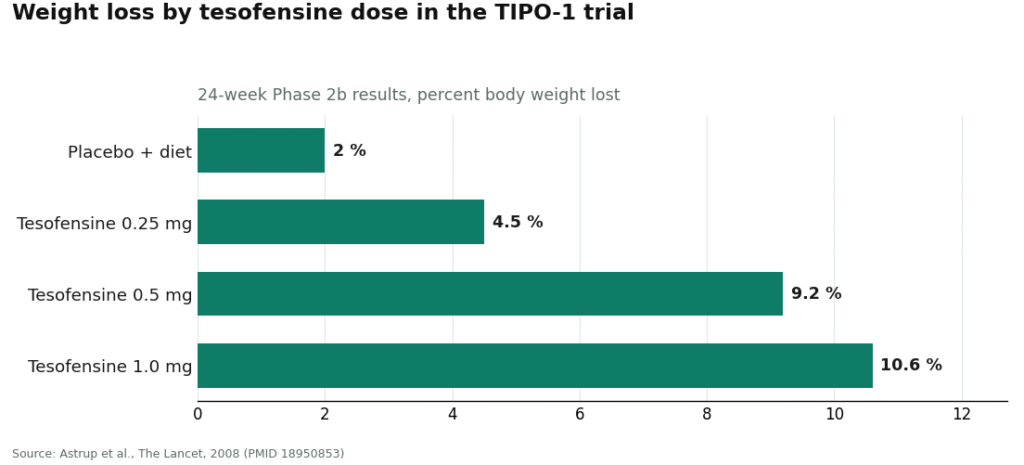
The figure that circulates most is from a Phase 2b trial known as TIPO-1, published in The Lancet in 2008. It was well designed: randomized, double-blind, placebo-controlled, run across five Danish obesity centers with 203 patients whose BMI ranged from 30 to 40, all following a calorie-restricted diet, over 24 weeks. People received either a placebo or tesofensine at 0.25, 0.5, or 1.0 mg daily. Average weight loss landed at 4.5%, 9.2%, and 10.6% across the rising doses, compared with 2.0% for diet plus placebo [P1].
Two things worth sitting with before getting excited about that top number. Diet alone accounted for 2.0% of the loss, so the honest drug effect, once you subtract that, is closer to 7.2% at 0.5 mg and 8.6% at 1.0 mg. Still meaningful for a mid-stage trial, just not quite the round double-digit figure that gets quoted. And the same trial recorded a heart rate increase of about 7.4 bpm in the 0.5 mg group [P1]. The top 1.0 mg dose raised blood pressure enough that it was dropped from later development entirely. What moved forward was capped at 0.25 and 0.5 mg, specifically to keep the cardiovascular effect tolerable.
The trial’s own authors were careful about this, writing that the 0.5 mg result “might have the potential to produce a weight loss twice that of currently approved drugs,” but adding that the finding “needs confirmation in phase III trials” [P1]. That confirmation still hasn’t landed in the United States, 17 years later.
Something else tells you how seriously the people closest to this drug took the heart rate question. Saniona, the company that later held the rights, ran a Phase 1 study (NCT03488719) to figure out how much of a heart-slowing beta blocker, metoprolol, would be needed to counteract tesofensine’s effect on heart rate. Their own documentation stated that heart rate “has been shown to be the most affected safety endpoint by the effects of tesofensine.” That study was paused over safety concerns and permanently ended in 2019 [P5]. Nobody builds a companion drug to cancel out a side effect they consider minor.
As of the public record in mid-2026, tesofensine remains unapproved by the FDA anywhere in the US, classified as an investigational new drug. The furthest it’s gotten regulatorily is a favorable technical opinion from Mexico’s COFEPRIS in early 2023, a procedural step in one country, not an approval. It’s not approved for obesity anywhere in the world right now. Because it’s a small molecule rather than a peptide, it wasn’t caught up in the FDA’s recent peptide-compounding restrictions, so it’s still available in the US through licensed 503A compounding pharmacies with a prescription.
How to actually go about this, if you’re considering it
Here’s a way to think about what trying tesofensine would really look like week to week: you’d effectively be running two ongoing check-ins on yourself, not one. There’s the number on the scale, which is what draws people in. But there’s also the number on a blood pressure cuff or a pulse check, which is the one that quietly reflects the same mechanism working in the background. Anyone thinking about this compound should plan on watching both, not just the one that shows up in before-and-after photos.
That’s exactly why the gap between a supervised medical path and buying something off a research-chemical website matters more here than it does with a lot of other compounds. On the supervised side, a provider like FormBlends functions as a licensed telehealth service, not a chemical vendor. A clinician takes a baseline heart rate and blood pressure, goes through your current medication list looking for anything that raises serotonin, decides whether 0.25 or 0.5 mg even makes sense for you, and checks back in on your numbers as time goes on. HealthRX sits in that same supervised category for the same reason, with clinical oversight built in before anything gets dispensed through proper pharmacy channels.
The unsupervised route strips out every one of those checks. Sellers marketing tesofensine as a “research chemical, not for human consumption” are using that exact language to stay on the right side of the law, because the moment it’s sold for people to actually take, it becomes an unapproved drug. Order it that way and nobody takes your baseline pulse. Nobody checks the vial against what else is in your medicine cabinet. Nobody is reachable if your resting heart rate starts climbing on its own. For a compound where the benefit and the risk come from the exact same neurochemical lever, cutting out the person watching that lever is about the worst trade you could make.
The takeaway
Think of tesofensine less as “a stronger weight-loss pill” and more as a triple monoamine reuptake inhibitor whose appetite-quieting effect and whose heart rate and interaction risks are the same story told from two directions. The roughly 10% weight loss from the Phase 2 trial is real. So is the 7 to 8 bpm rise in heart rate, the genuine overlap with some of the most common antidepressants and stimulants prescribed today, and the fact that the confirmatory trials the original researchers asked for haven’t produced a US approval in 17 years. None of that is contradictory. It’s all the same engine, viewed from different angles. Understand the engine, and the rest of the story makes sense on its own.
Questions worth answering
Is tesofensine stronger than Ozempic? Not really the right comparison. Ozempic and the other GLP-1 drugs work through gut hormones, while tesofensine works through brain chemistry, specifically serotonin, norepinephrine, and dopamine. They’re different systems entirely, so measuring one against the other for “strength” misunderstands what each drug is doing.
How does tesofensine actually suppress appetite? Mostly through its effects on norepinephrine and dopamine, not all three brain chemicals equally. A 2010 rat study found that blocking the norepinephrine-linked receptor nearly eliminated the appetite suppression, and blocking the dopamine receptor partly reversed it, while serotonin mattered less for eating behavior specifically. The drug keeps these chemicals active longer in appetite circuits, and hunger drops as a result.
Why does tesofensine raise heart rate? Because the same norepinephrine mechanism behind the appetite effect also drives heart rate. Norepinephrine is tied to the body’s “fight or flight” system, which speeds up the heart, so keeping it active longer has that predictable side effect. Trial data showed increases of roughly 7 to 8 bpm, making heart rate the standout cardiovascular finding.
What medications shouldn’t be combined with tesofensine? Anything that also raises serotonin. Combining it with an MAOI risks serotonin syndrome and a dangerous blood pressure spike, and layering it with an SSRI, an SNRI, a stimulant, or bupropion doubles up on the same pathway. These are common medications, which is exactly why a clinician reviewing your full medication list matters so much with this particular compound.
Is tesofensine FDA-approved? No. It’s classified as an investigational new drug in the US, and the promising Phase 2 results from 2008 haven’t turned into an approval in well over a decade. The furthest it’s progressed anywhere is a favorable technical opinion from Mexico’s regulatory body, COFEPRIS, in early 2023, which is a procedural step in one country, not an approval. As of mid-2026, it isn’t approved for obesity anywhere.
Why can compounding pharmacies offer tesofensine if it isn’t approved? Because it’s a small molecule rather than a peptide, it wasn’t affected by the FDA’s peptide-compounding restrictions, so licensed 503A compounding pharmacies can still prepare it with a prescription. That’s a separate question from approval status. On the other end of the market, research-chemical sellers list it as “for research use only,” which is the legal basis that lets the product exist, since marketing it for human use would make it an unapproved drug.
What is tesofensine and where did it come from?
Tesofensine started out as a candidate for Parkinson’s and Alzheimer’s disease. When trials showed only modest neurological benefit but a notable amount of weight loss as a side effect, researchers shifted focus toward obesity. It blocks the reuptake of serotonin, dopamine, and norepinephrine all at once, which is why it gets called a triple monoamine reuptake inhibitor.
Is tesofensine a peptide like semaglutide or tirzepatide?
No. It’s a small synthetic molecule, structurally closer to older stimulant-type diet drugs than to GLP-1 receptor agonists like semaglutide. That distinction shows up practically too: it’s taken as a pill rather than injected, and it acts on brain chemistry instead of gut hormone signaling, so the side effects and the way each drug curbs appetite look quite different from one another.
What does tesofensine actually do to appetite and energy?
It reduces appetite and appears to modestly raise resting energy expenditure, meaning the body burns a few extra calories even without extra movement. It does this by keeping dopamine, serotonin, and norepinephrine active longer in the synapse, which dampens hunger signals and may lift motivation somewhat. The appetite effect is fairly well supported by Phase 2 trial data. The metabolic boost is real but modest and shouldn’t be oversold.
Where can someone actually get tesofensine, and is it legal?
Because it hasn’t been approved by the FDA or most major regulators, there’s no standard pharmacy shelf to find it on. Some people turn to overseas research-chemical sellers, which comes with real risk around purity, accurate dosing, and legal gray zones. The steadier path is a physician-supervised compounding pharmacy, such as FormBlends, where a licensed prescriber oversees the process and the medication is prepared under proper quality controls.
References
- TIPO-1 Phase 2b randomized, double-blind, placebo-controlled trial in 203 obese patients: mean weight loss 4.5% / 9.2% / 10.6% at 0.25 / 0.5 / 1.0 mg vs 2.0% placebo over 24 weeks; heart rate +7.4 bpm at 0.5 mg; authors concluded the 0.5 mg result needs Phase 3 confirmation. Astrup et al., The Lancet, 2008. PMID 18950853. https://pubmed.ncbi.nlm.nih.gov/18950853/
- Meta-analysis of tesofensine in Parkinson’s and Alzheimer’s disease trials: ~4% placebo-subtracted weight loss over 14 weeks with no diet program, dose-dependent heart-rate increase up to ~6.8 bpm. Astrup et al., Obesity (Silver Spring), 2008. PMID 18356831. https://pubmed.ncbi.nlm.nih.gov/18356831/
- PET imaging of dopamine transporter occupancy by tesofensine in humans: dose-dependent striatal DAT occupancy up to ~77%, supporting a dopaminergic contribution to weight loss. Appel et al., European Neuropsychopharmacology, 2014. PMID 24239329.
- Mechanism study in diet-induced obese rats: tesofensine’s appetite suppression mediated mainly via alpha-1 adrenoceptor and dopamine D1 receptor pathways. Axel, Mikkelsen, Hansen, Neuropsychopharmacology, 2010. PMID 20200509.
- Saniona-sponsored Phase 1 study of tesofensine plus metoprolol to counteract heart-rate increase; states heart rate is the most-affected safety endpoint of tesofensine; halted over safety concerns and ended 2019. NCT03488719.
- Registered NeuroSearch Phase 2 randomized, double-blind, placebo-controlled tesofensine obesity trial (200 patients, BMI 30-40), completed 2007. NCT00394667.